
Xuan Kong Map Workbench Research Paper Published: Advancing Digital Feng Shui with Multi-source Geospatial Data and an Auditable Workflow
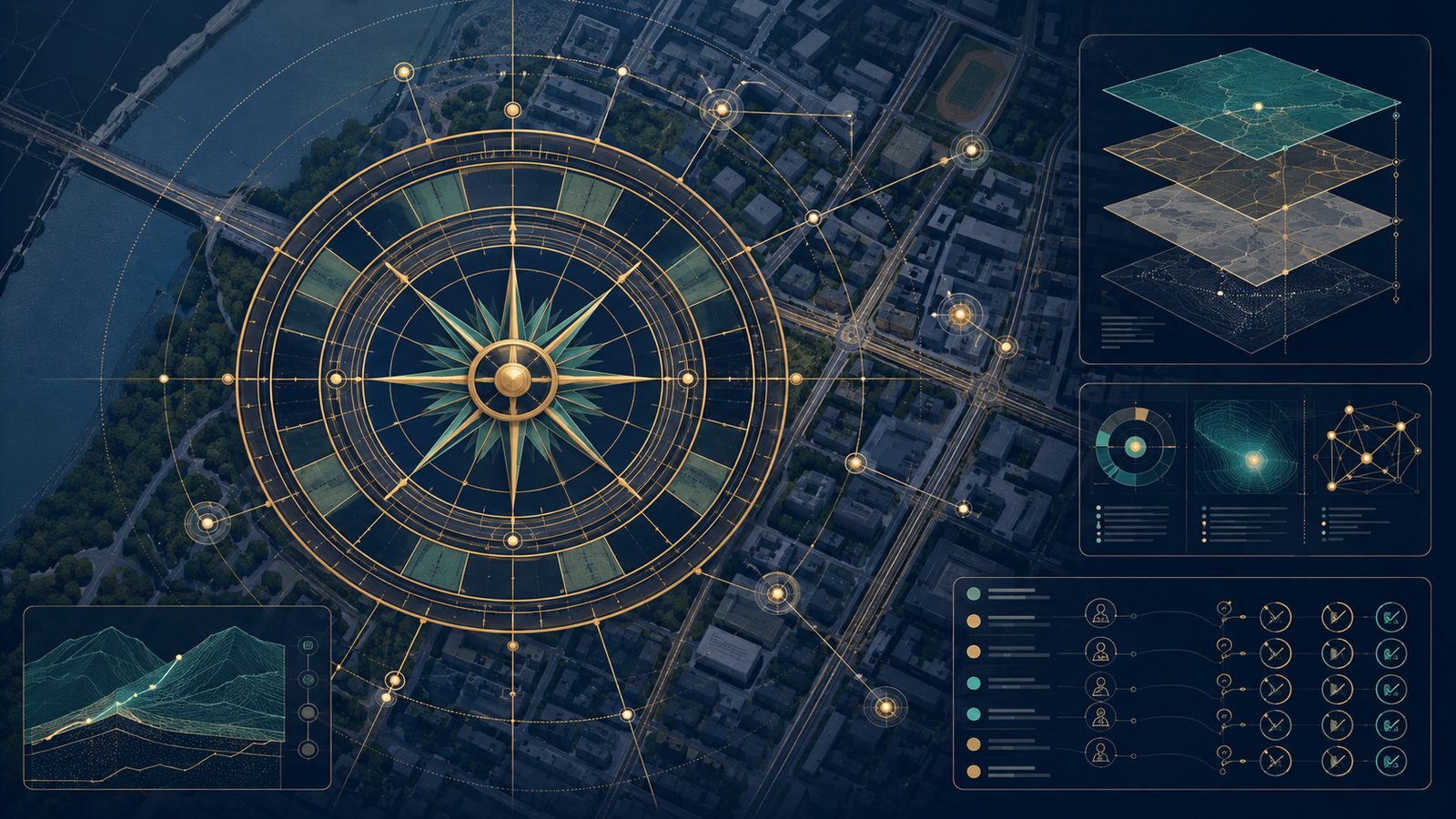
Toronto, Canada, 4 September 2026 — The Global Feng Shui Association research platform has published “From Compass Charting to Auditable Spatial Decision Support: Multi-source Geospatial Fusion, Pai Long Computation, and Human-in-the-loop Design of the Xuan Kong Map Workbench,” a research paper by Rowan. The paper documents an online system that starts from an address or map point and connects surrounding roads, building footprints, entrance information, Pai Long rules, Flying Stars charts and explainable orientation ranking in one workflow.
The research topic and project were independently conceived by Rowan, with Codex assisting implementation, structural verification and paper preparation. The purpose of the work is not to let software replace field measurement or professional judgement. It is to bring steps that were previously distributed across maps, compasses, chart tables and handwritten notes into a digital workflow in which data provenance, bearings, rule versions and intermediate results can be reviewed.
From isolated charting to contextual spatial analysis
The Xuan Kong Map Workbench integrates road, building-outline, entrance and navigation-point data available from OpenStreetMap/Overpass, Overture Maps and the Google Geocoding API. Road intersections and bends are treated as reviewable water-mouth candidate proxies. Building boundaries, nearby roads and geometric relationships are then used to infer facing and entrance candidates, while true north and magnetic north, the Twenty-four Mountains, twelve-palace Pai Long, direct or replacement Flying Stars methods, and the nine-palace chart remain separately recorded.
Unlike a tool that accepts a single compass angle and immediately returns a result, this design focuses on how a judgement was produced. Component scores can be expanded, data sources and algorithm versions are traceable, and the user can override both the water-mouth and orientation selections. Automation narrows the field for human review; it does not present heuristic ranking as unquestionable fact.
Reproducible structural verification
Using a design-science approach, the paper reports reproducible structural and consistency checks for the current version. The verification covers:
- 36,000 bearing samples at 0.01° intervals;
- 24 water-mouth mountain centres and their Pai Long matrices;
- the 180-year San Yuan and Nine Periods cycle;
- 432 house-chart combinations; and
- synthetic road and building geometries.
All defined structural invariants passed. This establishes repeatability and internal consistency under the encoded rules. It does not constitute scientific validation of real-world feng shui efficacy, and it cannot replace an on-site compass, terrain and hydrological assessment, observed entrance use or appropriately experienced professional judgement. The paper makes these evidence boundaries explicit in its abstract, method and limitations.
Four shifts for digital feng shui and professional governance
The paper describes the project's incremental contribution through four systems-engineering shifts: from isolated charting to contextual spatial analysis; from black-box conclusions to an auditable evidence chain; from a single data source to provenance-aware multi-source fusion; and from automated decision-making to overridable, traceable human-machine collaboration. Together, these shifts offer a reproducible basis for research into digital feng shui, the computation of cultural knowledge and the governance of professional services.
The next research phase will focus on de-identified field samples, agreement between experts, angular error, candidate Top-k hit rates, and sensitivity and calibration studies for heuristic weights. GFSA welcomes researchers and practitioners to read the full paper and engage with its published methods, limitations and evidence levels.