
Traditional Metaphysical Arts Have Not Disappeared - Only Their Interface Has Changed
Full Text / Details
Today, anyone can give an AI system their date and time of birth and receive, within seconds, an interpretation that once required payment and perhaps days of waiting. To a traditional practitioner, this can look like a sudden collapse in price. To the industry as a whole, it is more like a mirror. When chart calculation and generic interpretation become almost free, what value are we actually providing?
If we still imagine this field as a table on a street corner, a fortune stick drawn outside a temple, or a practitioner warning a caller that “next year brings an obstacle,” we will miss the scale of the change already under way.
A young person’s first encounter with fate calculation may now come through a short video rather than an older relative. They may open a charting website instead of entering a shop, and ask AI before paying a practitioner. Only when a job change, marriage, relocation, new business, or relationship crisis becomes real might they move from free content to a report, course, or one-to-one consultation.
Traditional metaphysical arts have not disappeared from everyday life. They have moved from a discreet, low-frequency, referral-based service into a hybrid sector combining content, software, platforms, education, advisory work, and cultural experience.
In this article, “metaphysical arts” is used as an industry term for divination, fate calculation, feng shui, astrology, tarot, and related cultural services. It does not refer to metaphysics as a branch of Western philosophy, nor does it imply scientific validation.
The short conclusion: this is a growing market, but not a market in which everyone can make easy money
Global figures can be exciting. They can also be badly misread.
Allied Market Research estimated the worldwide market for astrology-related products and services at US$12.8 billion in 2021 and projected that it could reach US$22.8 billion by 2031. In a Pew Research Center survey of 9,593 U.S. adults conducted in autumn 2024, 30% said they consulted astrology, tarot cards, or fortune tellers at least once a year.
The same Pew survey contains an even more important qualification: 20% did so mostly for fun, while only 1% said they relied “a lot” on these practices when making major life decisions.
The mainstream customer, then, is not necessarily searching for an irresistible decree of fate. More often, people want a new angle from which to understand themselves, a conversation that gives form to confusion, a rehearsal for a difficult choice, or simply a brief sense of stability during a stressful period.
The industry’s centre of value is therefore moving from “declaring the future” to “helping people interpret the present.” This is not merely a new marketing phrase. It is an operating principle that changes product design, professional skills, and ethical responsibility.
One old field, many different industrial forms
Across the Chinese cultural sphere, the most revealing question is not which society “believes more.” It is how similar human needs have been organized into very different markets.
Mainland China: visible attention, large demand, and an industry that remains difficult to measure
In Mainland China, Bazi, Zi Wei Dou Shu, Western astrology, tarot, temple visits, Five Elements fashion, lucky accessories, and AI-generated readings have been blended into a new social vocabulary among younger audiences. The trend combines renewed interest in traditional culture, emotional consumption under pressure, and topics amplified by content platforms.
A 2025 survey of 668 young respondents found that, within this strongly interest-oriented sample - 77.5% of whom were women - 60.0% followed Bazi or fate calculation, 44.8% astrology, and 38.9% tarot; 60.0% said they had tried AI divination. The sample cannot represent the national population, but it is useful for showing where active users gather and how they discover content.
Mainland China’s central contradiction is that attention is highly visible while the industry itself is not. Public statistics do not isolate a service category directly comparable with those available in Japan or Taiwan. Revenue is dispersed across individual consultations, courses, private communities, software, cultural products, and part-time work. At the same time, platforms and regulators are highly sensitive to superstition, coercive payment tactics, medical implications, and expensive promises to “remove misfortune.”
Practitioners cannot safely place their entire business inside a single social-media account. An independent website, knowledge base, client records, booking system, professional reports, and a durable branded entry point are moving from “useful extras” to operational necessities.
Taiwan: a modest formal market growing at exceptional speed
Taiwan is one of the few markets for which official statistics on fate-calculation services are available.
According to Taiwan’s Ministry of Finance, the formal category contained 194 registered businesses in 2024, with sales of approximately NT$290 million. Compared with five years earlier, the number of businesses had risen to about 2.6 times its former level, while sales had grown to roughly 5.1 times their previous level. Taipei, New Taipei, Taichung, and Taoyuan together accounted for 65% of businesses and 84% of sales. By the first ten months of 2025, the formal count had reached 222.
These figures do not capture every temple activity, part-time practitioner, cash transaction, or cross-border online service. They are better understood as a lower bound for the formal market. Even so, the direction is clear: a long-standing element of Taiwanese folk culture is becoming more visible through business registration, online delivery, and institutional branding.
Taiwan retains a strong base in Bazi, Zi Wei Dou Shu, name analysis, date selection, and feng shui, while also absorbing tarot, astrology, Human Design, and therapeutic language. This makes it a valuable testing ground for professional Traditional Chinese content, practitioner ethics, continuing education, and services for overseas Chinese communities.
Japan: not one popular app, but a mature content industry
Japan offers institutions the clearest view of what an industrialized ecosystem can look like.
Yano Research Institute estimated that six narrowly defined fortune-telling service segments in Japan generated a combined ¥99.7 billion in fiscal 2023. Web-based fortune media accounted for ¥37.2 billion, face-to-face services ¥28.7 billion, telephone readings ¥21.6 billion, skills-matching and online salons ¥6.5 billion, apps and social media ¥3.9 billion, and email or chat services ¥1.8 billion. Five of the six categories were growing.
The largest segment was not apps but media content. Nor did online services eliminate face-to-face and telephone consultation.
Publicly listed Japanese companies now combine fortune-telling content, telephone and chat services, intellectual-property characters, advertising acquisition, diagnostic APIs, corporate events, and data services within the same operating system. cocoloni states that it has more than 300 fortune-telling API products and a network of over 700 practitioners, enabling it to provide promotional campaigns, events, and content services to companies and local organizations.
The lesson is that an institution’s real asset is not simply “having a famous master.” It is the combination of content rights, expert networks, service procedures, distribution channels, data, customer support, and consumer-protection capability.
South Korea: Saju has entered apps, entertainment, and the capital market
South Korea is one of the most deeply digitalized examples in the Chinese cultural sphere.
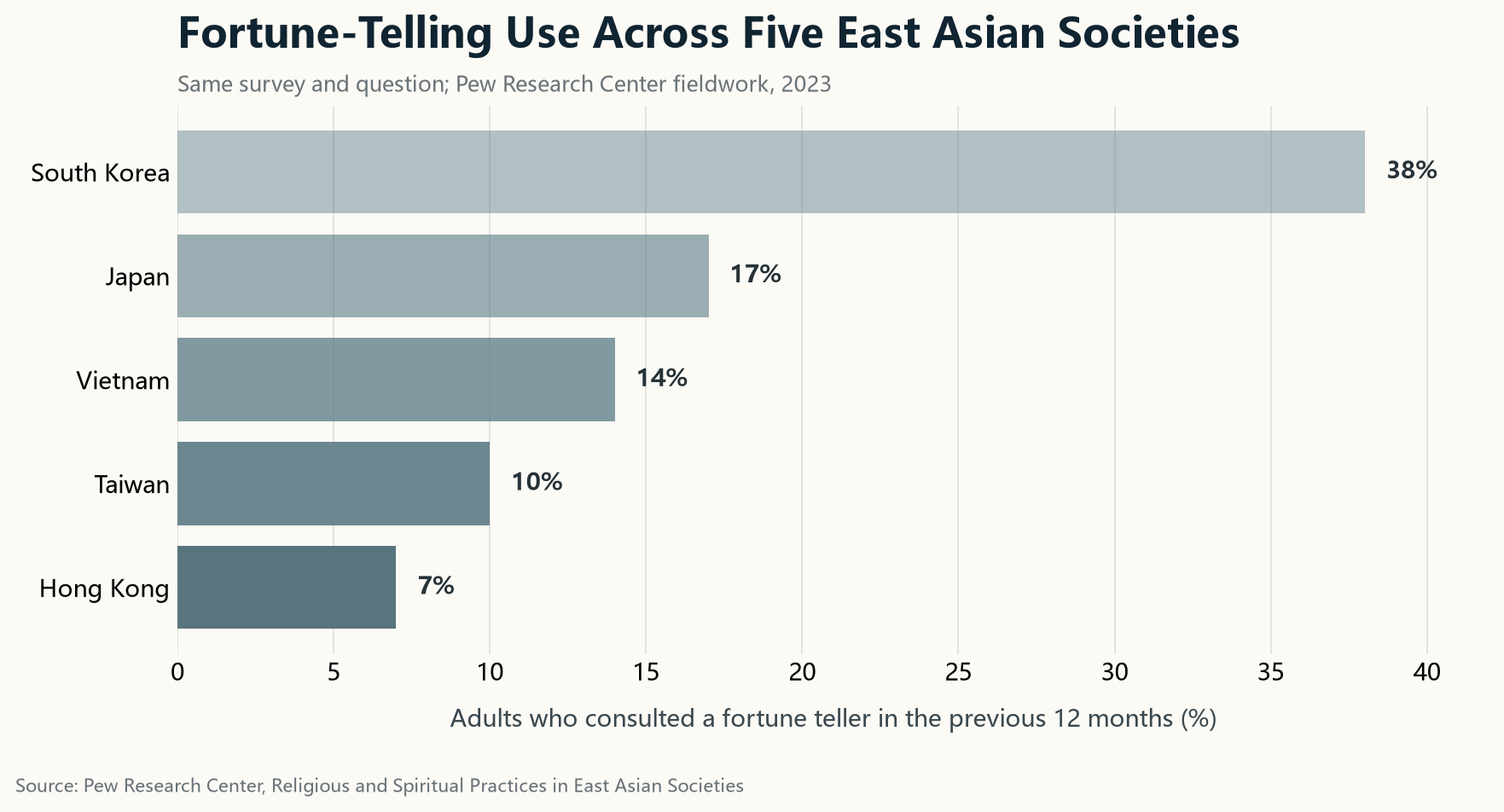
In a separate Pew survey conducted across five East Asian societies in 2023, 38% of South Korean adults said they had consulted a fortune teller during the previous year, compared with 17% in Japan, 14% in Vietnam, 10% in Taiwan, and 7% in Hong Kong. In 2024, South Korea counted 10,950 establishments classified as “fortune-telling and similar services,” an increase of 21.3% over three years. Employment reached 11,593, up 19.4%. Korean media have also cited an industry estimate of approximately KRW1.4 trillion, although this is not an official market account and its coverage has not been fully disclosed.
Saju, the Korean form of Four Pillars fate calculation, is based on a person’s birth year, month, day, and hour. Its structured inputs make it highly suitable for software. The market has consequently separated into three layers: free, high-frequency apps for daily guidance; content and character-led products for entertainment and paid media; and verified-expert platforms for higher-value one-to-one consultations.
Fortune-related content has also entered YouTube, social media, and streaming entertainment. In a 2026 survey of 1,200 people aged 13 to 69, 52.7% said they had encountered fortune-related content during the previous year, rising to 71.0% among people in their twenties. Among respondents, 73.3% said they took only the advice they considered worth hearing.
South Korea’s lesson is not that “everyone believes.” It is that once traditional knowledge is divided into clear product layers, the same ecosystem can serve entertainment audiences, tool users, and professional consulting clients.
Southeast Asia: “the overseas Chinese market” is not a sufficient strategy
In Singapore and Malaysia, feng shui and Bazi are often connected with residential and commercial property, corporate advisory services, brand launches, annual seminars, and high-net-worth clients. Bilingual Chinese-English capability, purchasing power, international connectivity, and cross-border Chinese networks make it possible to build chains linking a recognised practitioner, an academy, corporate services, and international courses.
Thailand has developed a different model. “Mutelu” blends astrology, feng shui, amulets, religious travel, beauty, fashion, and lucky consumption into popular culture. Krungsri Research, citing a 2024 survey, described a broad related market worth approximately THB10-15 billion. Only 164 astrology or belief-service companies were formally registered, illustrating how much of the value lies in tourism, retail, content, and informal services rather than narrowly classified consulting revenue.
In Vietnam, ancestor veneration, date selection, and household ritual are more deeply embedded in daily life. Pew found that 95% of Vietnamese households had an altar and that 14% of adults had consulted a fortune teller in the previous year. Urban young people in Indonesia increasingly encounter tarot, astrology, and New Age spirituality through social media, although religious sensitivities and content boundaries are more complex.
Southeast Asia is therefore not a single market into which a Chinese-language template can be copied. Language is only the first gate. Religion, custom, law, and local trust determine whether a project can endure.
When AI arrives, generic answers lose value first
AI’s effect on the sector is no longer hypothetical.
In a 2026 online survey by cocoloni of 1,020 Japanese adults aged 20 to 50, 33.9% said they had used ChatGPT or another AI system for divination. Among respondents in their twenties, the figure was 56.4% for men and 53.4% for women. In Thailand, 28.4% of Generation Z respondents said they were highly interested in immediately trying AI divination.
Chart calculation, generic personality descriptions, annual forecasts, basic questions, and multilingual translation will continue to become cheaper, and in many cases free. A service that does little more than restate a chart can no longer assume that it will sustain its former price.
AI also reveals where human value remains strongest: hearing concerns that a client has not stated directly; recognizing serious psychological risk; explaining differences between schools; connecting interpretation with real-world choices; taking responsibility for the advice process; and, when appropriate, saying, “This is not a matter for a divination practitioner. Please speak with a doctor, lawyer, or licensed adviser.”
The future professional will not compete with AI to produce the longest answer. The professional advantage will lie in dealing responsibly with a real person.
What practitioners often lack is not traffic, but infrastructure of their own
Many practitioners and institutions face the same operational disorder. Content sits on a social platform, clients are added to a messaging account, birth details are scattered across spreadsheets and screenshots, reports are copied manually, courses live in a separate group, and repeat business depends on memory. If an account is restricted, an assistant leaves, or the client volume rises, the whole service begins to lose control.
This is why the next phase of the sector will bring more institutional accounts, white-label portals, client management, professional charting, case libraries, booking, memberships, and API tools.
A good institutional tool should not erase the practitioner’s brand. It should allow a partner organization to use its own name, visual identity, team page, client entrance, courses, and cases. Technology should work in the background while the professional brand remains in front. A platform can provide common security, verification, and complaint procedures, but the client relationship should be able to develop into a durable asset of the institution itself.
For an individual practitioner, the minimum upgrade is equally clear: standardize service descriptions and prices; establish an independent entry point; use structured intake forms and consultation records; explain delivery and refunds; protect client privacy; and connect content, tools, consultations, and courses into one coherent path.
The larger the industry becomes, the less it can avoid science, ethics, and consumer protection
Studying a market is not the same as proving the scientific validity of divination. Modern controlled research has not produced evidence for astrological prediction that is generally accepted by the scientific community. The psychological “Barnum effect” also reminds us that people can interpret vague, broadly applicable, and positive descriptions as uniquely accurate accounts of themselves.
This does not mean that cultural practices have no meaning. It means practitioners must explain which elements are calendar calculation, which are school-specific interpretation, which are cultural tradition, and which are simply prompts for reflection. The more professional a service becomes, the less it needs to borrow words such as “quantum,” “frequency,” “genes,” or “neuroscience” as decorative proof.
Ethical boundaries should be concrete: do not guarantee 100% accuracy; do not frighten clients into paying by invoking disaster, curses, or death; do not promise investment returns; do not replace medical, psychological, legal, or financial professionals; do not misuse birth details, photographs, or family information; do not let “AI-generated” mean that no human is accountable; and establish clear stop-and-referral procedures for minors, domestic violence, self-harm, and severe mental-health crises.
Japan has strengthened consumer remedies against improper solicitation associated with so-called “spiritual sales.” In 2026, South Korea’s financial regulator warned against investment fraud packaged in the language of feng shui and Saju. Mainland China’s cyberspace authorities have cautioned users not to provide identity documents or other sensitive information to AI divination services and not to believe claims that payment is required to avert disaster.
The market is sending practitioners a clear message: ethics is not a slogan displayed on a wall. It is infrastructure for continuing to accept payment, remain listed, advertise, and operate across borders.
What should an association do? Build a trusted order, not merely issue more certificates
When a fragmented sector begins to mature, what it usually lacks is not another ranking of the “world’s greatest masters.” It lacks verifiable practitioner records, continuing education, complaint handling, data standards, service boundaries, and multilingual knowledge resources.
The Global Feng Shui Association can create greater public value by building the following shared capabilities:
- Verifiable profiles for members and partner institutions, so consumers can see who a provider is, what they specialize in, whether credentials remain valid, and whether a complaint process exists;
- Tiered member and institutional accounts, assigning different responsibilities to learners, professional practitioners, senior teachers, and team-based organizations;
- Core terminology resources in Chinese, English, Japanese, Korean, and Southeast Asian languages to reduce mistranslation in cross-border communication;
- Practical standards for ethics, privacy, advertising, and AI use, supported by contract clauses and communication templates that members can adopt directly;
- Anonymized cases and continuing education that accumulate knowledge about how to serve people, rather than only stories about who “predicted accurately”;
- Branded portals, client management, and professional tools that help institutions build durable identities of their own instead of working indefinitely for a platform.
The association’s credibility should not come from guaranteeing that someone is more “spiritually accurate.” It should come from something more ordinary and more important: those willing to be accountable for their service process can be clearly identified, while those who violate essential boundaries are recorded, suspended, or removed.
Final assessment: the scarce resource will not be answers, but trustworthy interpreters
From the global market to the Chinese cultural sphere, the sector is expanding. What is expanding is not only consumer spending, but also the number of content entry points, technical capabilities, professional roles, and social responsibilities.
Free charting will become more common. AI-generated answers will become longer. Short-video “predictions of the year” will not disappear. What will remain scarce are professional interpreters who can define boundaries, respect privacy, understand culture, handle complex circumstances, and help a person return to practical action.
Over the next five years, low-barrier content will continue to flourish and rapidly become homogeneous. Generic interpretation will face price pressure. High-quality personal brands, verified platforms, team-based institutions, bilingual cross-border services, and infrastructure offering client management, white-label portals, APIs, and compliance capability are more likely to earn stable revenue.
Modernizing traditional metaphysical arts does not mean replacing an old book with an app icon, or teaching AI to sound more like a master. It begins with renewed respect for the person seeking help: understanding that a visitor may be merely curious or may be standing at a turning point; offering an angle without taking away their judgment; recognizing their fear without monetizing it.
Tools will become more intelligent, and answers will become cheaper. The truly scarce professional will still be the person willing to listen carefully, explain the boundaries clearly, and help someone return to action in the real world.
References
- Pew Research Center: 3 in 10 Americans Consult Astrology, Tarot Cards or Fortune Tellers
- Pew Research Center: Religious and Spiritual Practices in East Asian Societies
- Taiwan Ministry of Finance: Fortune-Telling Services Statistics for 2024
- Yano Research Institute: Japan’s Fortune-Telling and Spiritual Business Market
- Krungsri Research: Thailand’s Mutelu Belief Economy
- South Korea: Industry Establishments and Market Reporting
- cocoloni: Japan’s 2026 Survey on AI Divination and Consumer Demand
- Cyberspace Administration of China: Risk Advisory on AI Divination
This article is based on publicly available information accessible as of July 13, 2026. Commercial forecasts and corporate surveys use different definitions and methodologies; distinctions have been preserved wherever possible.